The Great Courses - Physics and Our Universe: How It All Works - Richard Wolfson, Ph.D.
Shared by:ihophats
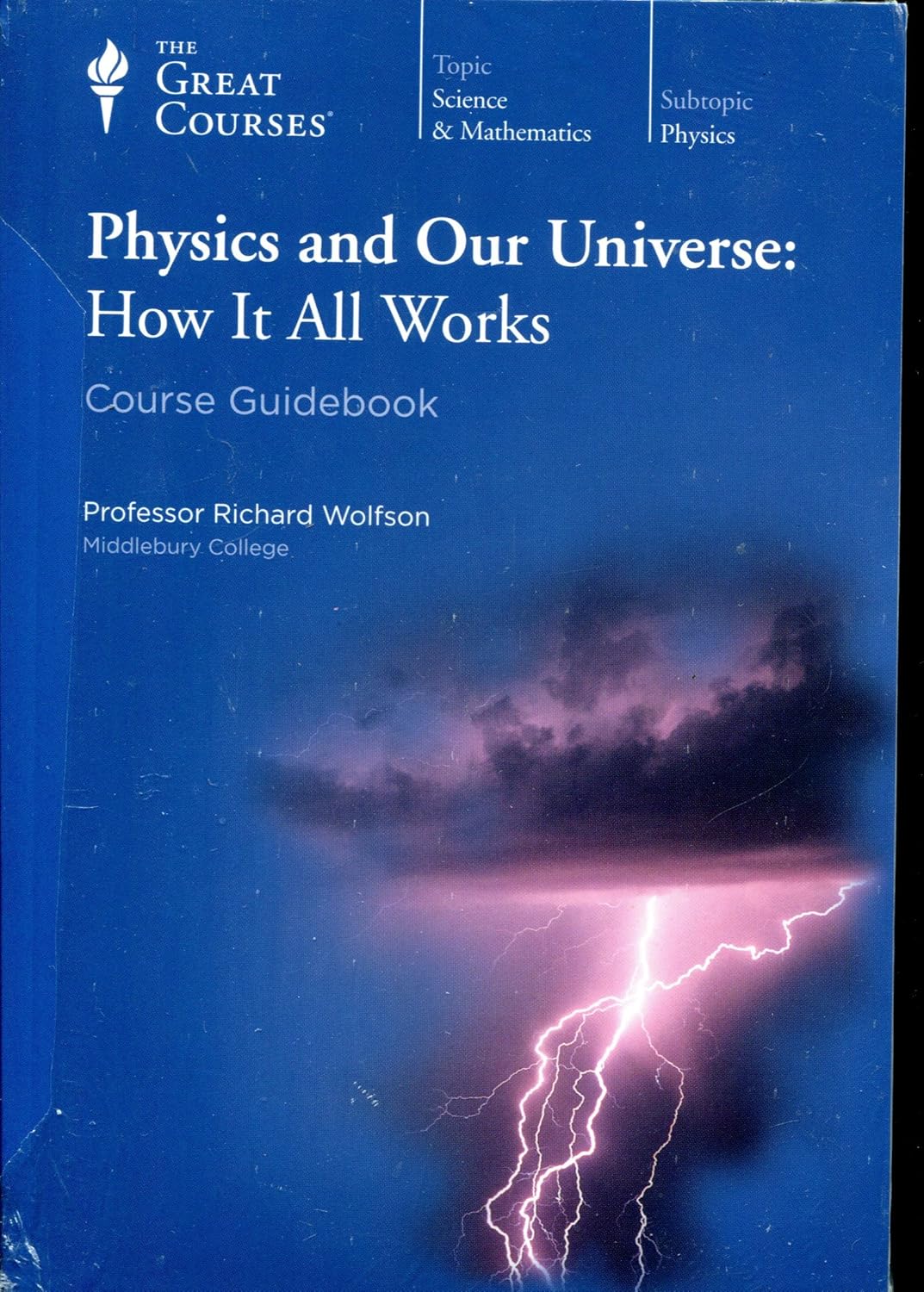
Written by ,
Read by Richard Wolfson, Ph.D.
Format: MP3
Bitrate: 64 Kbps
Length: 30 hr
Physics is the fundamental science. It explains how the universe behaves at every scale, from the subatomic to the extragalactic. It describes the most basic objects and forces and how they interact. Its laws tell us how the planets move, where light comes from, what keeps birds aloft, why a magnet attracts and also repels, and when a falling object will hit the ground, and it gives answers to countless other questions about how the world works.
Physics also gives us extraordinary power over the world, paving the way for devices from radios to GPS satellites, from steam engines to nanomaterials. It’s no exaggeration to say that every invention ever conceived makes use of the principles of physics. Moreover, physics not only underlies all of the natural sciences and engineering, but also its discoveries touch on the deepest philosophical questions about the nature of reality.
Which makes physics sound like the most complicated subject there is. But it isn’t. The beauty of physics is that it is simple, so simple that anyone can learn it. In 60 enthralling half-hour lectures, Physics and Our Universe: How It All Works proves that case, giving you a robust, introductory college-level course in physics. This course doesn’t stint on details and always presents its subject in all of its elegance—yet it doesn’t rely heavily on equations and mathematics, using nothing more advanced than high school algebra and trigonometry.
Your teacher is Professor Richard Wolfson, a noted physicist and educator at Middlebury College. Professor Wolfson is author or coauthor of a wide range of physics textbooks, including a widely used algebra-based introduction to the subject for college students. He has specially designed Physics and Our Universe to be entirely self-contained, requiring no additional resources. And for those who wish to dig deeper, he includes an extensive list of suggested readings that will enhance your understanding of basic physics.
Explore the Fundamentals of Reality
Intensively illustrated with diagrams, illustrations, animations, graphs, and other visual aids, these lectures introduce you to scores of fundamental ideas such as these:
Newton’s laws of motion: Simple to state, these three principles demolish our intuitive sense of why things move. Following where they lead gives a unified picture of motion and force that forms the basis of classical physics.
Bernoulli effect: In fluids, an increase in speed means a decrease in pressure. This effect has wide application in aerodynamics and hydraulics. It explains why curve balls curve and why plaque in an artery can cause the artery to collapse.
Second law of thermodynamics: Echoing the British novelist and physicist C. P. Snow, Professor Wolfson calls this law about the tendency toward disorder “like a work of Shakespeare’s” in its importance to an educated person’s worldview.
Maxwell’s equations: Mathematically uniting the theories of electricity and magnetism, these formulas have a startling outcome, predicting the existence of electromagnetic waves that move at the speed of light and include visible light.
Interference and diffraction: The wave nature of light looms large when light interacts with objects comparable in size to the light’s wavelength. Interference and diffraction are two intriguing phenomena that appear at these scales.
Relativity and quantum theory: Introduced in the early 20th century, these revolutionary ideas not only patched cracks in classical mechanics but led to realms of physics never imagined, with limitless new horizons for research.
A Course of Breathtaking Scope
The above ideas illustrate the breathtaking scope of Physics and Our Universe, which is broken into six areas of physics plus an introductory section that take you from Isaac Newton’s influential “clockwork universe” in the 17th century to the astonishing ideas of modern physics, which have overturned centuries-old views of space, time, and matter. The seven sections of the course are these:
Introduction: Start the course with two lectures on the universality of physics and its special languages.
Newtonian Mechanics: Immerse yourself in the core ideas that transformed physics into a science.
Oscillations, Waves, Fluids: See how Newtonian mechanics explains systems involving many particles.
Thermodynamics: Investigate heat and its connection to the all-important concept of energy.
Electricity and Magnetism: Explore electromagnetism, the dominant force on the atomic through human scales.
Optics: Proceed from the study of light as simple rays to phenomena involving light’s wave properties.
Beyond Classical Physics: Review the breakthroughs in physics that began with Max Planck and Albert Einstein.
As vast as this scope is, you will not be overwhelmed, because one set of ideas in physics builds on those that precede it. Professor Wolfson constantly reviews where you’ve been, tying together different concepts and giving you a profound sense of how one thing leads to another in physics. Since the 17th century, physics has expanded like a densely branching tree, with productive new shoots continually forming, some growing into major limbs, but all tracing back to the sturdy foundation built by Isaac Newton and others—which is why Physics and Our Universe and most other introductory physics courses have a historical focus, charting the fascinating growth of the field.
An interesting example is Newtonian mechanics. Developments in the late 19th century showed that Newton’s system breaks down at very high speeds and small scales, which is why relativity and quantum theory replaced classical physics in these realms. But the Newtonian approach is still alive and well for many applications. Newtonian mechanics will get you to the moon in a spacecraft, allow you to build a dam or a skyscraper, explain the behavior of the atmosphere, and much more. On the other hand, for objects traveling close to the speed of light or events happening in the subatomic realm, you learn that relativity and quantum theory are the powerful new tools for describing how the world works.
Seeing Is Believing
Physics would not be physics without experiments, and one of the engaging aspects of this course is the many on-screen demonstrations that Professor Wolfson performs to illustrate physical principles in action. With a showman’s gifts, he conducts scores of experiments, including the following:
Whirling bucket: Why doesn’t water fall out of a bucket when you whirl it in a vertical circle? It is commonly believed that there is a force holding the water up. But this is a relic of pre-Newtonian thinking dating to Aristotle. Learn to analyze what’s really going on.
Bowling ball pendulum: Would you bet the safety of your skull on the conservation of energy? Watch a volunteer release a pendulum that swings across the room and hurtles back directly at her nose, which escapes harm thanks to the laws of physics.
Big chill: What happens when things get really cold? Professor Wolfson pours liquid nitrogen on a blown-up balloon, demonstrating dramatic changes in the volume of air in the balloon. Discover other effects produced by temperature change.
Energy and power: How much power is ordered up from the grid whenever you turn on an electric light? Get a visceral sense by watching a volunteer crank a generator to make a light bulb glow. Try a simple exercise to experience the power demand yourself.
Total internal reflection: How does a transparent medium such as glass act as an almost perfect mirror without a reflective coating? See a simple demonstration that reveals the principle behind rainbows, binoculars, and optical fibers.
Relativity revelation: What gave Einstein the idea for his special theory of relativity? Move a magnet through a coil, then move a coil around a magnet. You get the same effect. But in Einstein’s day there were two separate explanations, which made him think …
Math for Those Who Want to Probe Deeper
Professor Wolfson doesn’t just perform memorable experiments. He introduces basic mathematics to analyze situations in detail—for example, by calculating exactly the speed a rollercoaster needs to travel to keep passengers from falling out at the top of a loop-the-loop track, or by showing that the reason high voltage is used for electrical power transmission is revealed in the simple expression that applies Ohm’s law, relating current and voltage, to the formula for power.
You also see how amazing insights can be hidden in seemingly trivial mathematical details. Antimatter was first postulated when physicist Paul Dirac was faced with a square root term in an equation, and instead of throwing out one of the answers as would normally have been done, he decided to pursue the implications of two solutions.
Whenever Professor Wolfson introduces an equation, he explains what every term in the equation means and the significance of the equation for physics. You need not go any further than this to follow his presentation, but for those who wish to probe deeper he works out solutions to many problems, showing the extraordinary reach of mathematics in analyzing nature. But he stresses that physics is not about math; it’s the ideas of physics that are crucial.
Understand the World in a New Way
Above all, the ideas of physics are simple. As you discover in this course, just a handful of important concepts permeate all of physics. Among them are
conservation of energy,
conservation of momentum,
second law of thermodynamics,
conservation of electric charge,
principle of relativity, and
Heisenberg uncertainty principle.
The key is not just to think in terms of these principles, but also to let go of common misconceptions, such as the idea that force causes motion; in fact, force causes change in motion. As you progress through Physics and Our Universe, you’ll inevitably start to see the world differently.
“I love teaching physics and I love to see the understanding light up in people’s eyes,” says Professor Wolfson. “You’ll see common, everyday phenomena with new understanding, like slamming on the brakes of your car and hearing the antilock brake system engage and knowing the physics of why it works; like going out on a very cold day and appreciating why your breath is condensing; like turning on your computer and understanding what’s going on in those circuits. You will come to a much greater appreciation of all aspects of the world around you.”

| Announce URL: | |
| This Torrent also has several backup trackers | |
| Tracker: | udp://tracker.open-internet.nl:6969/announce |
| Tracker: | udp://tracker.opentrackr.org:1337/announce |
| Tracker: | udp://tracker.tiny-vps.com:6969/announce |
| Tracker: | udp://tracker.vanitycore.co:6969/announce |
| Tracker: | udp://tracker.torrent.eu.org:451/announce |
| Tracker: | http://tracker.internetwarriors.net:1337/announce |
| Tracker: | http://tracker.vanitycore.co:6969/announce |
| Tracker: | http://retracker.telecom.by/announce |
| Tracker: | udp://tracker.leechers-paradise.org:6969 |
| Tracker: | udp://tracker.coppersurfer.tk:6969 |
| Tracker: | udp://open.demonii.si:1337/announce |
| Tracker: | udp://thetracker.org:80/announce |
| Tracker: | http://tracker2.dler.org:80/announce |
| Creation Date: | Wed, 02 Oct 2019 16:03:53 +0100 |
| This is a Multifile Torrent | |
| 01. The Fundamental Science.mp3 14.14 MBs | |
| 02. Languages Of Physics.mp3 14.28 MBs | |
| 03. Describing Motion.mp3 12.91 MBs | |
| 04. Falling Freely.mp3 13.92 MBs | |
| 05. It’s A 3-D World!.mp3 13.17 MBs | |
| 06. Going In Circles.mp3 13.67 MBs | |
| 07. Causes Of Motion.mp3 13.9 MBs | |
| 08. Using Newton’s Laws—1-D Motion.mp3 14.51 MBs | |
| 09. Action And Reaction.mp3 13.59 MBs | |
| 10. Newton’s Laws In 2 And 3 Dimensions.mp3 10.47 MBs | |
| 11. Work And Energy.mp3 14.1 MBs | |
| 12. Using Energy Conservation.mp3 13.67 MBs | |
| 13. Gravity.mp3 13.84 MBs | |
| 14. Systems Of Particles.mp3 13.84 MBs | |
| 15. Rotational Motion.mp3 3.16 MBs | |
| 16. Keeping Still.mp3 13.86 MBs | |
| 17. Back And Forth—Oscillatory Motion.mp3 14.46 MBs | |
| 18. Making Waves.mp3 12.95 MBs | |
| 19. Fluid Statics—The Tip Of The Iceberg.mp3 13.77 MBs | |
| 20. Fluid Dynamics.mp3 14.17 MBs | |
| 21. Heat And Temperature.mp3 2.62 MBs | |
| 22. Heat Transfer.mp3 5.88 MBs | |
| 23. Matter And Heat.mp3 13.91 MBs | |
| 24. The Ideal Gas.mp3 14.05 MBs | |
| 25. Heat And Work.mp3 14.01 MBs | |
| 26. Entropy—The Second Law Of Thermodynamics.mp3 14.14 MBs | |
| 27. Consequences Of The Second Law.mp3 14.04 MBs | |
| 28. A Charged World.mp3 14.46 MBs | |
| 29. The Electric Field.mp3 14 MBs | |
| 30. Electric Potential.mp3 13.99 MBs | |
| 31. Electric Energy.mp3 13.26 MBs | |
| 32. Electric Current.mp3 13.78 MBs | |
| 33. Electric Circuits.mp3 5.91 MBs | |
| 34. Magnetism.mp3 13.41 MBs | |
| 35. The Origin Of Magnetism.mp3 13.76 MBs | |
| 36. Electromagnetic Induction.mp3 14.33 MBs | |
| 37. Applications Of Electromagnetic Induction.mp3 13.1 MBs | |
| 38. Magnetic Energy.mp3 5.34 MBs | |
| 39. Acdc.mp3 14.03 MBs | |
| 40. Electromagnetic Waves.mp3 13.78 MBs | |
| 41. Reflection And Refraction.mp3 14.39 MBs | |
| 42. Imaging.mp3 13.58 MBs | |
| 43. Wave Optics.mp3 15.03 MBs | |
| 44. Cracks In The Classical Picture.mp3 10.31 MBs | |
| 45. Earth, Ether, Light.mp3 14.11 MBs | |
| 46. Special Relativity.mp3 13.8 MBs | |
| 47. Time And Space.mp3 14.31 MBs | |
| 48. Space-Time And Mass-Energy.mp3 7.06 MBs | |
| 49. General Relativity.mp3 13.96 MBs | |
| 50. Introducing The Quantum.mp3 13.86 MBs | |
| 51. Atomic Quandaries.mp3 14.34 MBs | |
| 52. Wave Or Particle.mp3 14.37 MBs | |
| 53. Quantum Mechanics.mp3 14.47 MBs | |
| 54. Atoms.mp3 14.28 MBs | |
| 55. Molecules And Solids.mp3 14.07 MBs | |
| 56. The Atomic Nucleus.mp3 13.99 MBs | |
| 57. Energy From The Nucleus.mp3 14.26 MBs | |
| 58. The Particle Zoo.mp3 13.77 MBs | |
| 59. An Evolving Universe.mp3 14.02 MBs | |
| 60. Humble Physics—What We Don’t Know.mp3 14.58 MBs | |
| Physics and Our Universe How It All Works.pdf 3.15 MBs | |
| Combined File Size: | 779.89 MBs |
| Piece Size: | 512 KBs |
| Comment: | Updated by AudioBook Bay |
| Encoding: | UTF-8 |
| Info Hash: | faface7059f34e4706af55784587a50c1f613d5f |
| Torrent Download | Torrent Free Downloads |
| Tips | Sometimes the torrent health info isn’t accurate, so you can download the file and check it out or try the following downloads. |
| Direct Download | Start Direct Download |
| Tips | You could try out alternative bittorrent clients. |
| Secured Download | Download Files Now |
| Ad |

|






This post has 3 comments
October 3rd, 2019
I suspect the keyword “Astrology” should be “Astronomy” :-)
October 11th, 2019
A shame I’m finding corrupted episodes in this completed download. Should be ~30 minutes long but cuts out partially through quite a few chapters.
February 24th, 2021
Any chance you can seed a tiny bit more, or re-up , I would love to get this book , loads of thanks if you can, Roz
Add a comment (please log in before commenting)